Upcoming Sessions
- There are no upcoming sessions scheduled
See All Upcoming Sessions

An informational in-service which forms part of the required training. In compliance with 381.0035, F.S. Florida Statutes and the Developmental Disabilities IBudget . Fla. Department of Health 4 Hours Read more
Rating
Content
Price

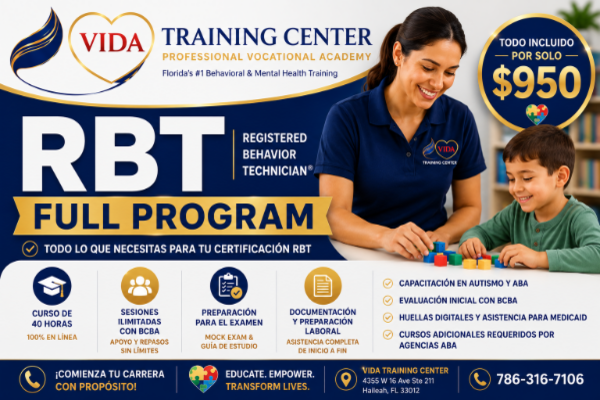
What's Included in the Complete RBT Program? ✔ 40 Hour RBT Training Course ✔ Unlimited BCBA Support Sessions ✔ Unlimited Content Review Sessions ✔ Complimentary Autism & ABA Training ✔ Level 2 Fingerprinting & Medicaid Background Screening Assistance ✔ Initial Competency Assessment with a BCBA ✔ Bilingual Digital Study Guide/ Bilingual E-Book ✔ Intensive 6 Hour Board Exam Review ✔ Mock Board Examination ✔ Documentation & Application Assistance ✔ Employment Readiness In Service Trainings ✔ Additional Professional Development Courses Commonly Required by ABA Agencies Exceptional Value If purchased separately, these services have a combined value of over $1,350. With Vida Training Center's Complete RBT Certification Preparation Program, you receive everything for only $850. One Program. One Team. Complete Support from Enrollment to Certification and Employment Readiness. __________________________________ ¿Qué Incluye el Programa Completo? ✔ Curso de Capacitación RBT de 40 Horas ✔ Sesiones Ilimitadas de Apoyo con un BCBA ✔ Sesiones Ilimitadas de Repaso de Contenido ✔ Capacitación Complementaria en Autismo y ABA ✔ Asistencia con Huellas Dactilares y Verificación de Antecedentes Nivel 2 para Medicaid ✔ Evaluación Inicial de Competencias con un BCBA ✔ Guía de Estudio Digital Bilingüe (Inglés y Español) ✔ Repaso Intensivo de 6 Horas para el Examen del Board ✔ Examen Simulado (Mock Exam) para Preparación del Board ✔ Asistencia con Documentación y Proceso de Aplicación ✔ Capacitaciones de Inducción y Preparación Laboral para Empleo en Agencias ABA ✔ Cursos Adicionales de Desarrollo Profesional Frecuentemente Requeridos por Agencias ABA Valor Excepcional Si adquiriera todos estos servicios por separado, el valor combinado excedería los $1,350. Con el Programa Completo de Preparación para la Certificación RBT de Vida Training Center, recibe todos estos servicios por solo $850. Un Solo Programa. Un Solo Equipo. Apoyo Completo Desde su Inscripción Hasta la Certificación y Preparación para el Empleo. En Vida Training Center, estamos comprometidos a acompañarlo durante todo el proceso, brindándole la capacitación, orientación y recursos necesarios para alcanzar sus metas profesionales en el campo del Análisis Aplicado de la Conducta (ABA). Read more
Rating
Content
Price
Online Registered Behavior Technician (RBT) Training (3rd Edition) Course Overview: This comprehensive online course is designed to prepare individuals for the role of a Registered Behavior Technician (RBT), a key position in the field of Applied Behavior Analysis (ABA). The course provides 40 hours of training, covering all the necessary topics outlined by the Behavior Analyst Certification Board (BACB) for the RBT credential. Through interactive modules, videos, and practical examples, participants will gain a deep understanding of behavior analysis principles and learn how to implement behavior intervention plans. Key Features: 100% Online and Self-Paced Complimentary autism and ABA training Unlimited questions and answers sessions with certified instructor (call to schedule) 40-Hour Training in Accordance with BACB Guidelines Interactive Quizzes and Case Studies Support from Certified Behavior Analysts Certificate of Completion to Apply for the RBT Exam Learning Outcomes: By the end of this course, participants will: Understand the key principles of behavior analysis Be able to accurately implement behavior intervention plans Demonstrate proficiency in data collection and behavior assessment Learn professional and ethical behavior in client interactions Be prepared to pass the RBT competency assessment and exam Ideal for: Individuals looking to start a career in behavior analysis Educators and paraprofessionals working with individuals with developmental disabilities Family members of individuals with autism or other developmental disorders Anyone interested in learning ABA principles Certification: Upon successful completion, participants will receive a certificate of completion that qualifies them to take the RBT exam. Duration: 40 Hours within 30 day course access: after the 30 day mark from date of enrollment, students are responsible to pay an extension of $75 for every additional month they would like to extend it. no more than 5 extensions allowed. Read more
Difficulty
Content
Price

Our HHA course prepares individuals to provide essential care and support to patients in their homes. This includes assisting with daily activities, monitoring health status, and a ensuring safe and comfortable environment. Our curriculum includes: -Personal Care Skills: training in bathing, grooming, dressing, and feeding resident. -Health Monitoring: learning to monitor vital signs and recognize changes in health status. -Home Safety: Understand safety protocols for patients in a home environment. -Communication Skills: Develop effective communication techniques for interacting with patients and families. -Ethics and Professionalism: Gain insights into ethical considerations and maintaining professional boundaries. Our curriculum includes a combination of online and in-person hands-on skills. Open daily enrollment, please call our offices upon enrollment to obtain the in-person dates. (786-)-316-7106 Upon completion of our HHA program, students will also have obtained the preparation to challenge the Certified Nursing Assistant state board exam if desired. _____________________________________________________________________________________________________ Nuestro curso de HHA prepara a individuos para brindar cuidado y apoyo esenciales a pacientes en sus hogares. Esto incluye asistir en actividades diarias, monitorear el estado de salud y asegurar un entorno seguro y confortable. Nuestro plan de estudios incluye: Habilidades de Cuidado Personal: entrenamiento en baño, arreglo personal, vestimenta y alimentación de residentes. Monitoreo de la Salud: aprendizaje para monitorear signos vitales y reconocer cambios en el estado de salud. Seguridad en el Hogar: comprensión de protocolos de seguridad para pacientes en entornos domésticos. Habilidades de Comunicación: desarrollo de técnicas efectivas de comunicación para interactuar con pacientes y familias. Ética y Profesionalismo: adquisición de conocimientos sobre consideraciones éticas y mantenimiento de límites profesionales. Nuestro plan de estudios combina clases en línea con prácticas presenciales. Matrícula abierta diariamente, por favor llame a nuestras oficinas al inscribirse para obtener las fechas de las prácticas presenciales. (786-)-316-7106 Al completar nuestro programa de HHA, los estudiantes también estarán preparados para presentarse al examen estatal para la certificación como Asistente de Enfermería Certificado si así lo desean. Read more
Rating
Content
Price

Working as a Behavior Technician in a rehabilitative or residential center for adults treated for mental health and substance use disorders can be a rewarding yet challenging role. Here’s an overview of what such centers are like and what your responsibilities might entail: Overview of Rehabilitative or Residential Centers Purpose Types of Services Role of a Behavior Technician Read more
Rating
Content
Price

This presentation is a basic introduction of what suicide is, the prevalence of suicide, risk factors, warning signs, and protective factors. Read more
Rating
Content
Price
Shopping Cart
Your cart is empty